Automotive manufacturers and suppliers manage vast amounts of multilingual content throughout the product lifecycle. From technical manuals and workshop documentation to software interfaces, training materials and aftersales support, every document must remain accurate, consistent and aligned with brand terminology.
Successful automotive translation is no longer simply about converting text from one language to another. It requires structured localisation workflows, terminology management and specialist linguistic expertise to ensure content remains consistent.
Why Automotive Documentation Requires Specialist Translation
The automotive industry relies on highly technical content that supports manufacturing, compliance, servicing, sales and customer experience. Even small terminology inconsistencies can create confusion across departments, suppliers or international markets.
Specialist automotive translators understand both the language and the technical context, helping manufacturers deliver consistent multilingual documentation throughout the product lifecycle.
Consistent Terminology Is Critical
Vehicle manufacturers often develop their own approved terminology for components, systems and processes.
Maintaining approved glossaries, terminology databases and structured localisation workflows helps ensure every document uses consistent language, regardless of department or target market.
This becomes increasingly important when managing:
- Technical manuals
- Workshop documentation
- Training materials
- Marketing content
- Software interfaces
- Aftersales documentation
Collaboration Improves Quality
Many automotive organisations involve in-country reviewers and subject matter experts as part of the localisation process.
Combining specialist translators with local reviewers helps validate terminology, maintain brand consistency and improve quality across multilingual documentation.
Feedback from reviewers can then be incorporated into future projects through terminology management and technology-enabled localisation workflows, reducing duplicated effort over time.
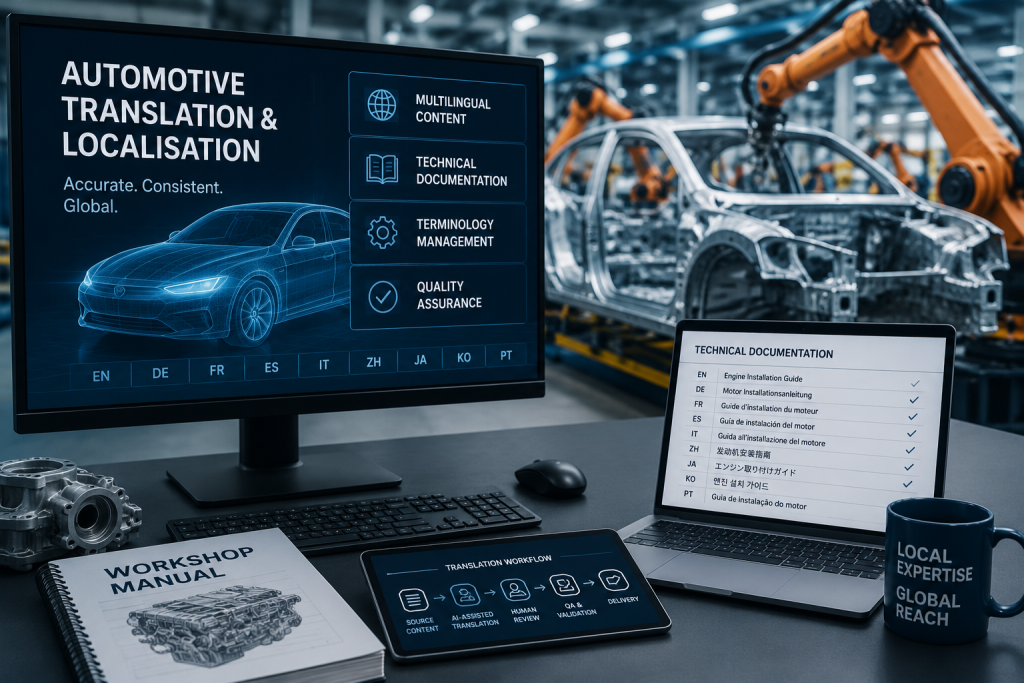
Today’s automotive localisation programmes combine specialist human expertise with AI-assisted translation, terminology management and structured review processes.
These workflows help organisations:
- Maintain terminology consistency
- Accelerate multilingual releases
- Reduce repetitive translation
- Improve collaboration across global teams
- Support continuous documentation updates
Rather than replacing human expertise, technology enables localisation teams to work more efficiently while maintaining the quality expected in technical industries.
Automotive Translation Across the Product Lifecycle
Automotive localisation frequently supports:
- Technical documentation
- Workshop manuals
- Owner’s manuals
- Product launches
- Dealer communications
- E-learning and training
- Marketing campaigns
- Software and HMI localisation
- Warranty documentation
- Customer communications
Managing these content types through a structured multilingual workflow helps organisations improve consistency while supporting international growth.
Closing Thoughts
As automotive products become increasingly connected and global supply chains become more complex, multilingual documentation has become a strategic business asset rather than simply a translation requirement.
Whether supporting manufacturers, Tier 1 suppliers or aftermarket brands, structured localisation workflows help maintain quality, consistency and efficiency across every language and market.
Learn more about our Automotive Translation & Localisation Services and how ALM supports global automotive organisations with multilingual content throughout the product lifecycle.