EU Machinery Regulation 2027: What Could It Mean for Language Requirements?
The new EU Machinery Regulation, Regulation (EU) 2023/1230, becomes applicable on 20 January 2027, replacing the existing Machinery Directive 2006/42/EC for machinery placed on the EU market from that date.
The regulation updates the European machinery safety framework to reflect developments in connected machinery, safety-related software, artificial intelligence, cybersecurity, and digital documentation. The European Commission identifies cyber-safety, AI-powered safety functions and the digital provision of instructions as important elements of the new framework.
For manufacturers, machine builders and automation providers, the transition is not solely an engineering or conformity-assessment issue. It could also affect how technical information is written, translated, updated and delivered across different EU markets.
Does the new Machinery Regulation change language requirements?
The regulation does not create a general requirement to translate every document into every official EU language.
However, it requires instructions for use, safety information and the relevant information specified in Annex III to be provided in a language that can be easily understood by users, as determined by the Member State concerned. That information must also be clear, understandable and legible.
In practice, manufacturers will need to assess their language requirements on a market-by-market basis. The appropriate language may depend on:
- where the machinery is being placed on the market
- who will install, operate and maintain it
- whether the intended users are professionals or not
- the type and safety significance of the information
- requirements applied by the relevant Member State
For UK manufacturers exporting machinery into the EU, the important consideration is where the product is being placed on the market, not simply where the manufacturer is based.
An English-language master manual may continue to form the basis of the documentation process, but it should not automatically be assumed that an English-only version will meet the requirements of every destination market.
The language review should extend beyond the main manual
Machinery documentation is rarely limited to one operating manual. Information can be distributed across printed documents, digital platforms, machine interfaces and supporting software.
A documentation review may therefore need to consider:
- operating and maintenance manuals
- installation and commissioning instructions
- troubleshooting and service documentation
- safety warnings and machine labels
- HMI text, alarms and system messages
- PLC-related user information
- instructions for software updates and remote access
- declarations and other conformity documentation
- assembly instructions for partly completed machinery
- online help, QR-code destinations and digital document portals.
Not every item will necessarily have the same legal or translation requirement. However, inconsistencies between these different content types can create operational and safety risks.
For example, a warning may be translated accurately in the operating manual but expressed differently on the HMI. A maintenance procedure may use one component name while the spare-parts catalogue uses another. An online manual may be updated while the translated version available to the local service team remains unchanged.
The introduction of new regulatory requirements provides manufacturers with an opportunity to review the complete multilingual information environment around each machine, not just the principal PDF manual.
Digital instructions do not remove the need for translation
One of the most significant changes is the clearer provision for instructions for use to be supplied in a digital format.
Where manufacturers provide digital instructions, the regulation establishes conditions around access and availability. Users must be told how to access the instructions, and the format must allow them to print, download and save the information so that it remains accessible when required. Digital instructions must remain available online during the expected lifetime of the machinery and for at least ten years after it is placed on the market.
Where a user requests a paper copy at the time of purchase, the manufacturer must provide it free of charge within one month. Additional paper-format provisions apply to essential safety information where machinery is intended for non-professional users or could reasonably be used by them.
Digital delivery therefore changes the method of distribution, but not the underlying need for understandable information.
Uploading one English-language PDF to a website is unlikely to represent a complete multilingual documentation strategy. Manufacturers may also need to consider whether:
- the instructions for accessing the document are translated
- users can identify the correct language version
- the manual corresponds to the correct model and configuration
- the translated document matches the current software version
- previous versions remain controlled and traceable
- users can download the document for offline access
- the correct content remains available throughout the product’s lifetime
For machinery businesses with multiple product families and destination markets, this can quickly become a content-management issue as much as a translation issue.
Digital documentation increases the importance of version control
Digital documentation can make it easier to update technical information, correct errors and support machinery throughout its operational lifetime. It can also create new risks if source and translated versions are not updated together.
A manufacturer may have several versions of the same machine in operation, each with different:
- hardware configurations
- safety components
- software releases
- operating modes
- maintenance requirements
- regional specifications.
The document supplied to a user must be relevant to the machine they are operating. This becomes particularly important where software or configuration changes affect safety-related behaviour.
A structured multilingual workflow should therefore connect engineering changes with documentation and localisation updates. When an approved source instruction changes, the business should be able to identify:
- which documents are affected
- which product versions use that content
- which languages require updating
- which translated documents are currently available to users
- whether HMI, software or training content also needs revision
Without this connection, digital delivery can make outdated translations easier to distribute rather than easier to control.
Cybersecurity could generate new safety-related content
The Machinery Regulation introduces stronger consideration of cyber-safety where digital interference could affect the safe operation of machinery. The European Commission describes the regulation as integrating provisions for compliance-relevant software data and safety control systems.
This does not mean that every cybersecurity document automatically becomes part of the translated operating instructions. It does mean that manufacturers should identify information users, engineers and service teams need in order to maintain safe machine operation.
Depending on the machinery, relevant content could include:
- approved remote-access procedures
- authorised software and firmware updates
- access permissions and user roles
- warnings about unauthorised modifications
- safety-related configuration settings
- checks required after an update
- system recovery procedures
- instructions following a communication or control-system failure
Terminology is particularly important in this area. Concepts such as safety function, authorised modification, remote access, software integrity and protective measure should be used consistently across the risk assessment, operating manual, service instructions and machine interface.
Where different teams interpret the same translated term differently, the problem is no longer simply linguistic. It can affect how the machinery is configured, maintained and operated.
Partly completed machinery requires specific attention
The regulation also addresses language requirements for partly completed machinery.
Assembly instructions must be provided in a language that can be easily understood by the person incorporating the partly completed machinery, as determined by the relevant Member State. They must also be clear, understandable and legible.
This is particularly relevant to complex automation projects involving components and systems from multiple international suppliers.
The final integrator may need to understand:
- the conditions under which a component can be incorporated;
- limitations affecting the completed machinery;
- safety functions already provided;
- safeguards that remain to be installed;
- control-system interfaces;
- residual risks;
- software and configuration dependencies;
- checks required before commissioning.
The required language may therefore be influenced by the integrator and technical team responsible for incorporation, not only by the language of the machine’s eventual operator.
This should be considered when documentation moves through an international supply chain. Waiting until the final machine is ready for delivery may be too late to resolve terminology or translation problems in component-level assembly instructions.
What should manufacturers review before January 2027?
Manufacturers do not need to translate every available document simply because the regulation is changing. The priority should be to identify the information that supports safe use, incorporation, maintenance and market access, then establish how it will be managed across the required languages.
Map products, markets and users
Identify which products will be placed on the EU market from 20 January 2027 and the Member States in which they will be supplied.
For each product, establish who will install, operate, service and integrate the machinery. The language needs of a system integrator may differ from those of a production operator or maintenance engineer, as seen in ALM’s work with Ishida, where documentation for integrators and end operators required separate terminology and delivery formats.
Audit the complete information set
Review more than the main operating manual. Include installation guides, maintenance documentation, labels, HMI content, alarms, digital access instructions, software information and assembly instructions.
The objective is to determine where safety-related and operational information appears and whether it remains consistent.
Establish controlled technical terminology
Create an approved terminology resource for:
- components and assemblies
- operating modes
- hazards and residual risks
- protective devices
- safety functions
- software and cybersecurity concepts
- recurring warnings and instructions
Controlled terminology improves consistency across documents and reduces the time required to translate future revisions.
Connect engineering changes to translation updates
Document revisions should trigger a review of affected language versions. This is particularly important where a change affects safety instructions, software behaviour, HMI text or maintenance procedures.
Translation should form part of the product-release workflow rather than treated as a separate final-stage activity.
Test digital access by market and language
Test the documentation process from the user’s perspective.
Can a user identify the correct manual? Can they select the appropriate language? Does the document correspond to the machine and software version? Can it be downloaded and printed? Are the access instructions themselves understandable?
These practical checks can expose weaknesses that are not visible from within the manufacturer’s internal document system.
Multilingual compliance requires more than individual translations
The move towards connected machinery and digital documentation is likely to increase the importance of structured localisation workflows.
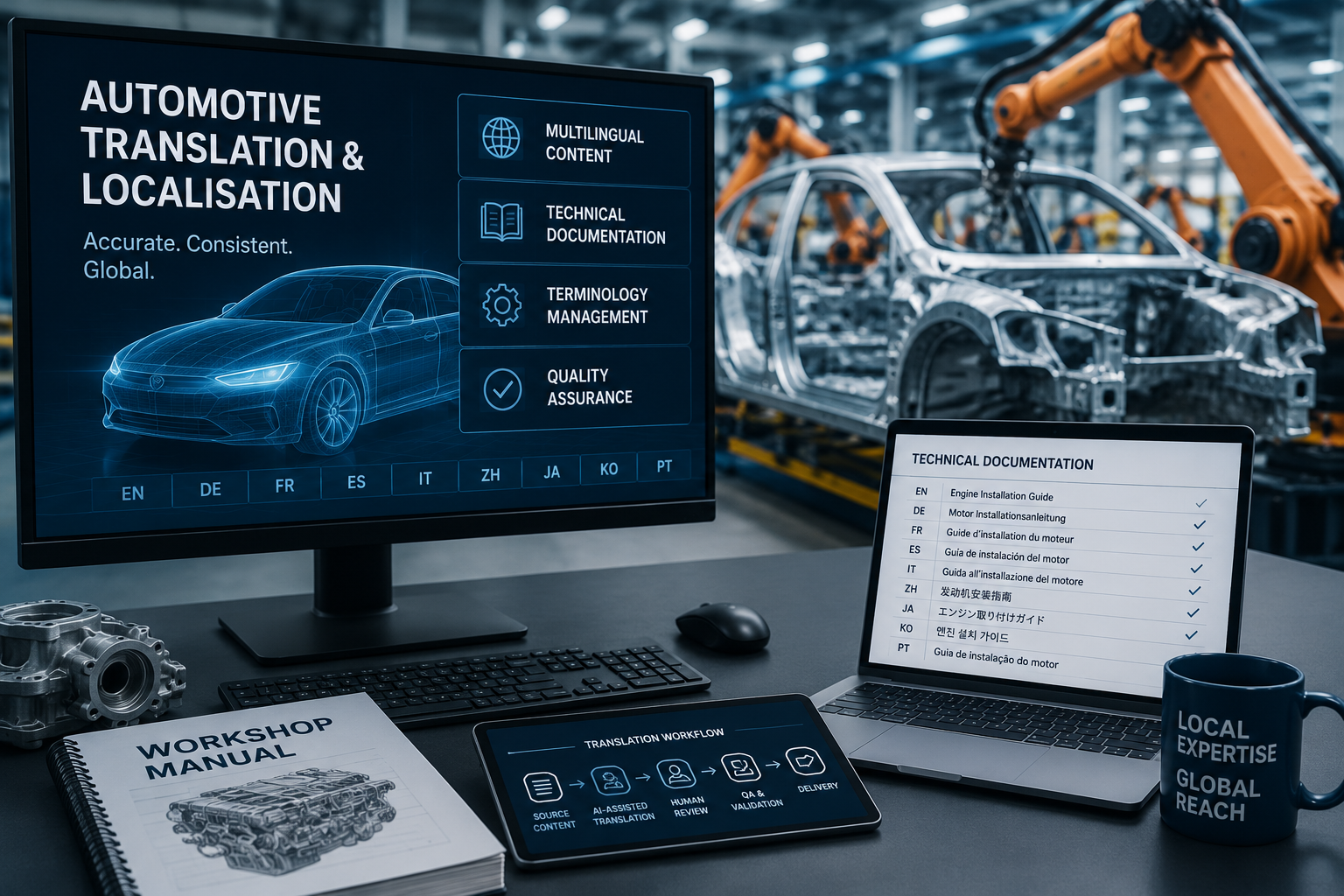
Manufacturers may need to manage multiple languages across manuals, OMM documentation, HMI and PLC content, safety information, software releases and supporting technical documents. Handling each file as an isolated translation project can lead to duplicated work, inconsistent terminology and poor revision control.
A centralised workflow can help manufacturers:
- maintain approved terminology across products
- reuse previously translated technical content
- identify changes between document versions
- keep manuals and interfaces aligned
- coordinate internal technical reviews
- maintain traceability across languages
- reduce duplication across repeat documentation
ALM supports manufacturers, machine builders and industrial automation providers with multilingual machinery manuals, OMM documentation, HMI and PLC software, installation guides and other technical content. AI-driven workflows, terminology management and structured localisation workflows help maintain consistency across product versions and international markets.
Preparing multilingual documentation for 2027
Regulation (EU) 2023/1230 becomes applicable on 20 January 2027. Machinery placed on the EU market before that date remains subject to the current Machinery Directive, while machinery placed on the market from the application date will need to follow the new regulatory framework.
The transition provides a useful opportunity for manufacturers to review:
- which languages are required in each market
- where safety and operating information is located
- how digital instructions will be accessed
- whether terminology is consistent
- how translated versions will be updated
- whether the correct document can be traced to each machine configuration.
The central question is not simply, “Have we translated the manual?”
It is:
Can every relevant user, engineer or integrator access the correct, current and understandable information for the machinery they are working with?
Organisations that address that question early will be better placed to manage multilingual documentation as machinery becomes more connected, software-driven and digitally supported. Contact ALM to audit the current multilingual set-up supporting machinery documentation.
Preparing machinery documentation for EU markets?
Speak to ALM about creating a more controlled, consistent and scalable localisation workflow for your technical manuals, HMI content and multilingual operational documentation.
This article is intended to provide general information and does not constitute legal, regulatory or conformity-assessment advice. Organisations should confirm the requirements applicable to their machinery, users and target markets with an appropriately qualified compliance specialist.